Enjoy free worldwide shipping on all our handcrafted blades!
Types of Blades: The Complete Guide to Knife Blade Shapes (2026)

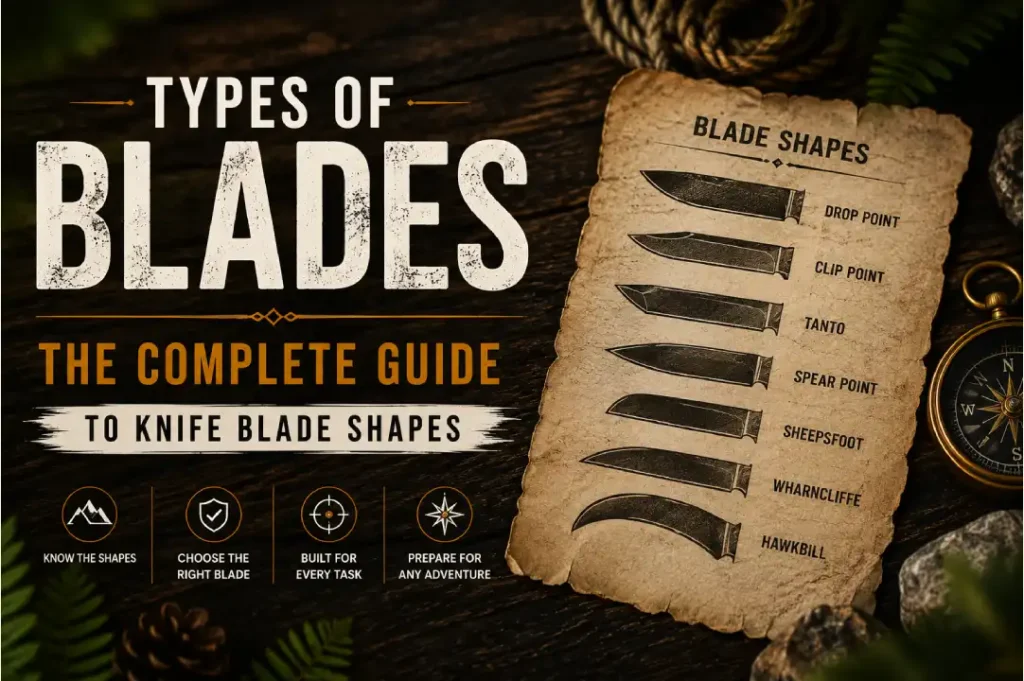
Pick up ten knives and you’ll likely find ten different blade shapes. Some are built to pierce. Some are built to slice. A few are built to survive a decade of hard use in the field. Pick the wrong one and you end up fighting your knife instead of the job in front of you.
This guide walks through every major types of blades you’ll run into, what each one does best, and how to match a shape to your hands and your work.
What Are the Different Types of Blades?
Knife blades fall into a handful of core shapes: drop point, clip point, tanto, spear point, sheepsfoot, and wharncliffe are the six you’ll see most often. Beyond those, more than a dozen specialized shapes exist for narrower jobs — rope cutting, skinning game, close-quarters defense, chopping. Each shape trades off point strength, slicing belly, and control differently, so there’s no single “best” blade shape. There’s only the right shape for what you’re cutting.
Blade shape refers to the outline of the blade — the silhouette you’d see if you traced it on paper. That’s different from the grind (how the steel is beveled to form the edge) and the edge type (plain or serrated). All three affect performance, and we’ll cover each of them in this guide, because understanding one without the others only gets you half the picture.
Blade Anatomy: The Terms You’ll See Throughout This Guide
A few terms come up in every blade shape description below. Knowing them makes the rest of this guide easier to follow.
- Tip — the very end of the blade, where piercing and fine detail work happen.
- Edge — the sharpened cutting line, which can run straight, curved, or a mix of both.
- Spine — the unsharpened top of the blade, which adds strength and largely determines the tip’s shape.
- Belly — the curved section of the edge that does most of the work in a slicing cut.
- Ricasso — the short, flat, unsharpened section of blade closest to the handle, useful for choking up on the blade for control.
- Tang — the portion of the blade steel that extends into the handle; a full tang runs the entire length of the handle for maximum strength.
- Grind — how the steel is beveled from spine to edge to form the cutting bevel, covered in its own section below.
The Most Common Knife Blade Shapes
These six shapes cover the vast majority of knives sold in the US, from kitchen drawers to hunting packs.
1. Drop Point
A drop point blade has a spine that slopes gently down toward the tip, keeping the point close to the centerline and easy to control. That control matters most when you’re field dressing game — you want a point that won’t nick internal organs by accident. Combined with a generous belly for slicing, the drop point is the closest thing to an all-purpose blade shape. If you only own one knife, it’s probably this one.
2. Clip Point
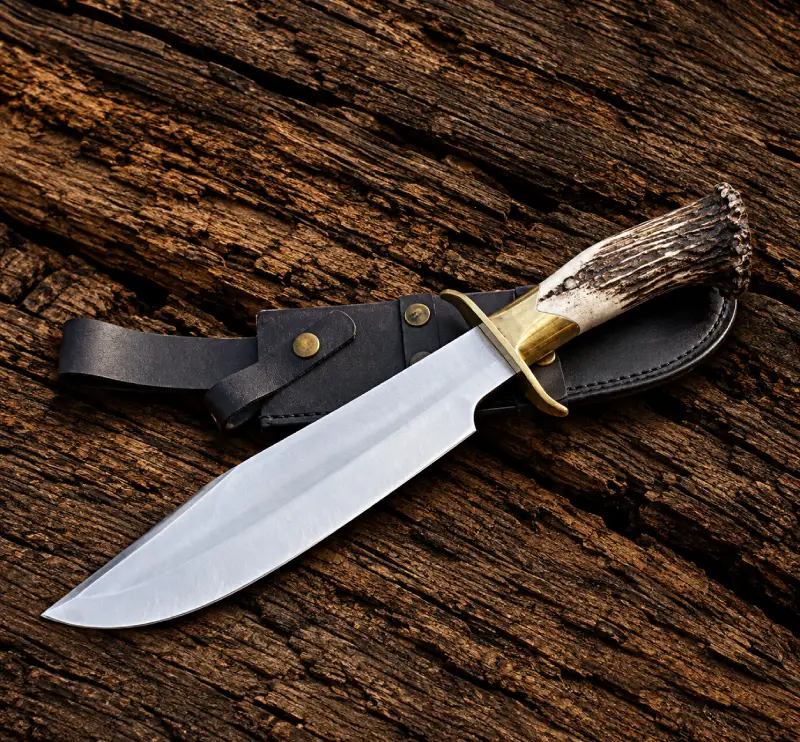
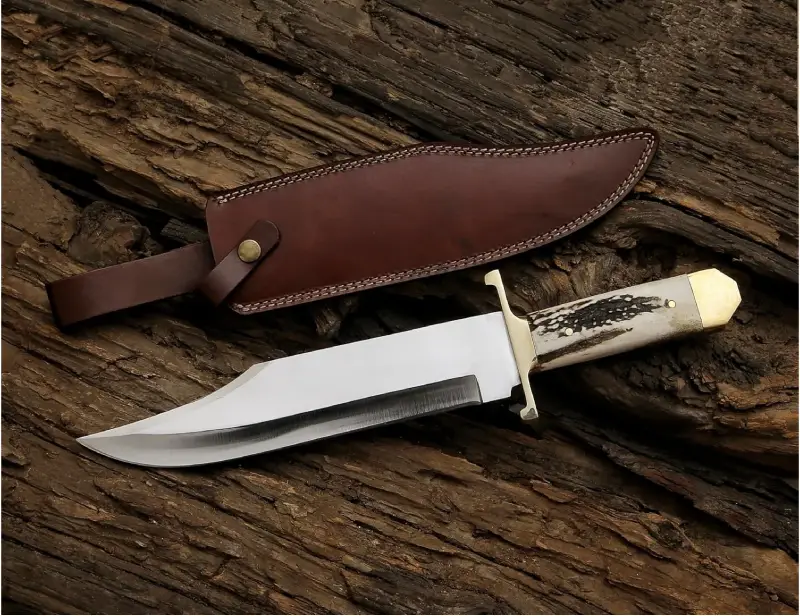
A clip point looks like someone sliced a triangle off the spine near the tip, either in a straight or concave cut. That “clip” thins out the point, making it sharper and better suited to detail work than a drop point. The trade-off is durability — a thinner point flexes and snaps more easily under prying pressure. Classic Bowie knives and a lot of traditional pocket knives use this shape.
3. Tanto
Borrowed from Japanese sword design, the tanto blade has a high, flat-ground point where the edge meets the spine at an angle instead of a curve. That angular geometry makes the tip exceptionally strong — good for piercing tough materials like cardboard, drywall, or even light metal. What you lose is belly. Tanto blades aren’t built for slicing, so they make poor kitchen or utility knives but strong tactical ones.
4. Spear Point
A spear point is symmetrical, with the tip sitting directly on the blade’s centerline. That symmetry makes it excellent for piercing and thrusting, which is why you’ll see it on throwing knives and combat blades. When both edges are sharpened, a spear point becomes a dagger. It’s not a great choice for chopping or heavy prying — the geometry favors going in straight, not levering sideways.
5. Sheepsfoot
A sheepsfoot blade trades the point away entirely. The edge runs straight, and the spine curves down to meet it without forming a sharp tip. That makes it one of the safest shapes to work with — first responders use sheepsfoot blades to cut seatbelts close to a body without risking a puncture. It’s also the blade shape behind the santoku, a kitchen knife built for clean, controlled slicing.
6. Wharncliffe
The wharncliffe looks like a sheepsfoot’s more precise cousin: a straight edge, a spine that curves down toward it, but with enough curve retained to keep a fine, usable point. Originally designed as a whittling knife in the 1800s, it’s become popular again on modern EDC knives because it combines controlled slicing with just enough tip for detail work.
More Blade Shapes: The Full Picture
The six shapes above cover most knives you’ll handle day to day. The table below rounds out the rest — shapes built for narrower, more specific jobs, from field dressing to close-quarters defense.
| Blade Shape | Best For |
| Trailing Point | Skinning and filleting — a large curved belly with a thin, upswept tip |
| Hawkbill | Cutting rope and carpet, pruning — the inward hook concentrates force on a pull cut |
| Recurve | Slicing tasks that need extra belly — deep S-curve edge, harder to sharpen |
| Straight Back | Heavy chopping and batoning — a thick, flat spine takes pressure from your palm |
| Bowie | Hunting and outdoor survival — a large clip-point blade built for fighting and utility |
| Kukri | Chopping power — a forward-curved, heavy belly that swings like a small machete |
| Karambit | Close-quarters defense and utility — a small, deeply curved claw shape drawn from Southeast Asian farming tools |
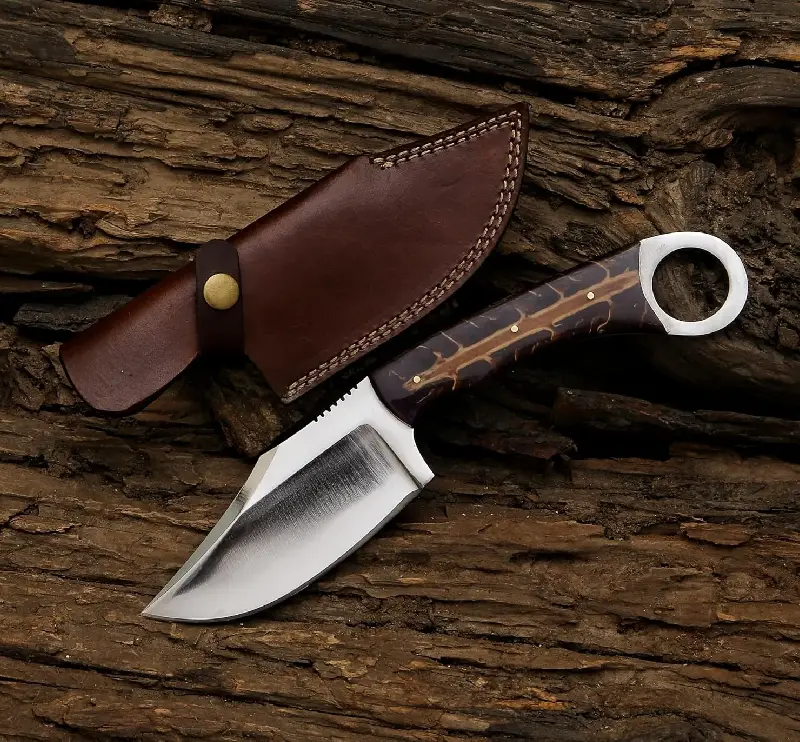
| Gut Hook | Field dressing game — a hook ground into the spine that opens hide without puncturing internal organs |
| Spey Point | Skinning and utility work — a blunt, rounded tip originally designed for safer livestock work |
| Needle Point / Dagger | Deep piercing — a thin, symmetrical, often double-edged blade built purely for penetration |
| Leaf Blade | General-purpose cutting and piercing — a continuous curve from spine to edge, one of the oldest blade shapes in use |
| Cleaver | Heavy kitchen chopping — a broad, rectangular blade with weight concentrated toward the tip |
| Reverse Tanto | EDC slicing with a reinforced tip — a tanto-style point blended with a curved slicing belly |
Blade Grinds: The Other Half of Blade Geometry
Blade shape decides the outline. Grind decides how the edge actually cuts once you’re through that outline — and two knives with the same shape can perform very differently depending on which grind they use.
| Grind | Best For | Trade-off |
| Flat | All-around slicing; easy to sharpen | Less durable at the edge than a convex grind |
| Hollow | Very thin, very sharp edges for fine slicing | Weaker edge; needs more frequent honing |
| Convex | Chopping and heavy-use blades; also called an “axe grind” | Harder to sharpen without a strop or slack belt |
| Sabre | Balancing strength and cutting ability on survival knives | Thicker behind the edge than a full flat grind |
| Chisel | Extremely sharp, single-bevel precision cuts | Only sharp on one side; handedness matters |
Blade Shapes by Use Case: Kitchen, Hunting, Tactical, Swords & Axes
The same blade shapes show up again and again once you look across categories — just adapted to the job at hand.
Kitchen Knives
A chef’s knife blends drop point and clip point traits into a broad, curved belly built for the classic rocking chop. Santoku and nakiri knives use a sheepsfoot-style straight edge for push cuts instead. Paring knives shrink a spear or drop point down for close, controlled work.
Hunting & Outdoor Knives
Drop point dominates this category for its controllable tip during field dressing. Trailing point blades show up for skinning and caping, where a big belly matters more than a strong point. Straight back and kukri shapes take over for camp chopping and batoning firewood.
Tactical & EDC Knives
Tanto and spear point shapes lead when piercing is the priority. Wharncliffe and clip point blades are more common on folding EDC knives, where a blend of utility and precision beats raw piercing power. Hawkbill shapes fill a narrow niche for rescue and cutting cordage.
Swords
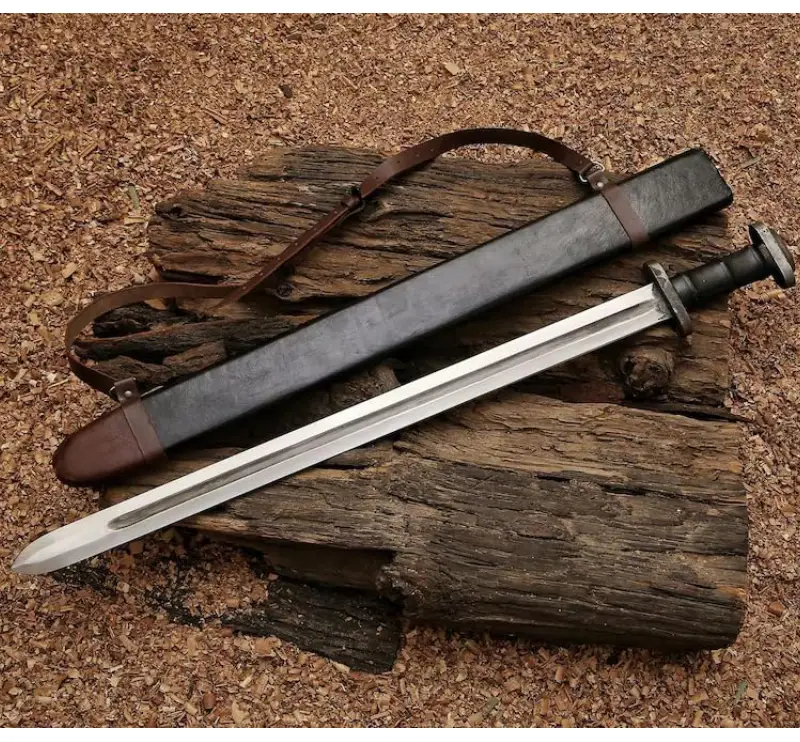
A straight or leaf-shaped blade balances cutting weight evenly along its length, which is why both show up across centuries of sword design. Single-edge blades curve to favor a draw cut; double-edge blades stay straighter to balance thrust and cut. At Gladius Forging, the same shape principles that guide a drop point knife — where the weight sits, how the tip is finished — scale up to guide how a sword blade is drawn out on the anvil.
Axes
An axe head isn’t a knife blade shape at all — the cutting bit is really a wedge, shaped to split wood rather than slice it. But grind still matters here: a convex grind, the same geometry used on hard-use camp knives, is what lets an axe head part wood without binding in the cut.
Types of Blades on Knives: Fixed vs. Folding
Blade shape choice also shifts depending on what kind of knife you’re building or buying. Fixed blades — hunting knives, kitchen knives, survival knives — have more freedom in the shop, so drop point, straight back, and trailing point shapes dominate, since there’s no lock mechanism or folding pivot to design around.
Folding and pocket knives lean toward clip point, wharncliffe, sheepsfoot, and tanto shapes instead. These profiles grind well on shorter blade stock and pair naturally with a folding lock, which is part of why they’re so common on modern EDC knives.
Blade Shapes Compared: Quick Reference
| Blade Shape | Piercing | Slicing | Durability |
| Drop Point | Good | Very Good | Very Good |
| Clip Point | Very Good | Good | Moderate |
| Tanto | Excellent | Poor | Excellent |
| Spear Point | Excellent | Moderate | Good |
| Sheepsfoot | Poor | Very Good | Good |
| Wharncliffe | Moderate | Very Good | Good |
How to Choose the Right Blade Shape for Your Needs
Match the shape to the job before you match it to looks. A few starting points:
- Hunting or field dressing: drop point for control, trailing point or gut hook if skinning is the main task.
- Everyday carry or general utility: drop point or wharncliffe.
- Tactical use or piercing hard materials: tanto or spear point.
- Kitchen prep or cutting near skin (rope, seatbelts, bandages): sheepsfoot.
- Heavy chopping or camp tasks: straight back or kukri.
- Close-quarters defense or a hooking cut: karambit.
If you’re not sure, start with a drop point. It handles the widest range of tasks reasonably well, which is exactly why it shows up on more hunting knives, EDC blades, and kitchen knives than any other shape.
Why Blade Shape Matters More on a Handmade Blade
On a mass-produced knife, blade shape comes from a die — every unit is identical, for better or worse. A hand-forged blade is different. The shape is drawn out and ground by hand, which means small differences in geometry — where the belly starts, how the point is finished, how much distal taper runs down the spine — have a much bigger effect on balance and edge retention than they would on a stamped blade.
That’s the whole idea behind Gladius Forging: knives, swords, and axes shaped by hand rather than punched from a sheet. Forged by Hand, Built to Last isn’t just a tagline here — it’s the reason blade shape is worth understanding before you buy one.