Enjoy free worldwide shipping on all our handcrafted blades!
What Is a Kukri Knife? History, Uses & Real-World Value 2026

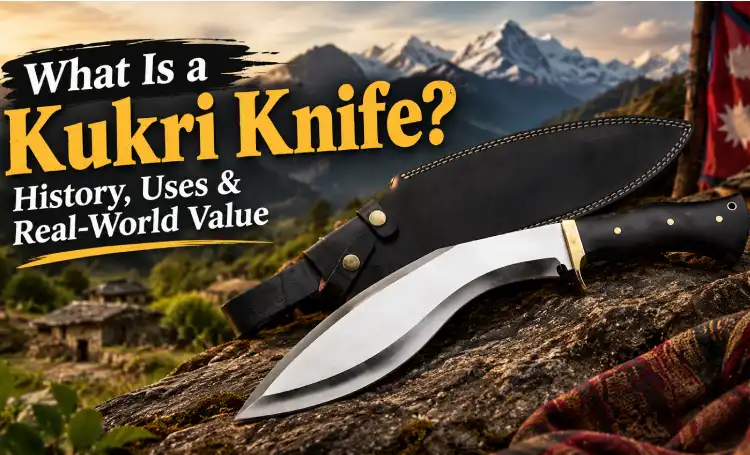
A kukri knife is a curved, forward-weighted fixed-blade knife that originated in Nepal, traditionally carried by Gurkha soldiers and hill communities across the Himalayas. Its inward curve isn’t decorative — it shifts the blade’s mass toward the tip, turning a single swing into a chop with far more force than a straight blade of the same length. That’s the short answer. Here’s the fuller picture, including what it’s actually used for today and what a real one costs.
In this guide, we’ll break down what is a kukri knife is, what it’s actually used for, and how much you should expect to pay for a genuine one.
What Is a Kukri Knife, Exactly?
A kukri (also spelled khukuri or khukri) is a fixed-blade knife with a distinct forward curve, typically ranging from 10 to 18 inches in overall length. The blade widens and curves inward toward the tip, concentrating weight where it does the most cutting work. Most traditional kukris also have a small notch near the base of the blade, called the “cho,” which stops blood or sap from running onto the handle and marks a clean break point between the sharpened edge and the unsharpened spine.
It’s recognized as the national knife of Nepal. Historians disagree on exactly how old the design is — some trace its shape back roughly 2,500 years to the Greek kopis, a curved blade said to have entered the region with Alexander the Great’s forces in the 4th century BC, while others link it to earlier Himalayan hill tribes. What’s not disputed is its military reputation: the kukri became internationally known through the Gurkha regiments of the British and Indian armies, where it’s still issued today as both a tool and a ceremonial weapon.
What Is a Kukri Knife Used For?
The kukri’s reputation as a weapon sometimes overshadows what it was actually built for day to day: heavy outdoor work. The forward curve makes it one of the most efficient chopping tools you can carry on a belt, and its uses fall into a few clear categories.
Everyday Outdoor and Camp Tasks
- Clearing brush and trail-cutting through dense vegetation
- Splitting kindling and processing firewood
- Digging and light shelter-building work
- Field-dressing and processing game after a hunt
Traditional and Cultural Roles
- Ceremonial use in Gurkha regiments and Nepalese households
- A rite-of-passage or heirloom gift in parts of Nepal
- Symbolic display piece for collectors and military history enthusiasts
Modern Everyday Carry and Collecting
Outside Nepal, most kukris sold today serve one of two roles: a genuine outdoor working tool for campers, hunters, and bushcrafters, or a collector’s piece prized for its blade geometry and craftsmanship. A well-made kukri handles both without much overlap — the balance and edge geometry that make it useful in the field are the same details collectors look for.
How Much Is a Kukri Knife Worth?
Kukri prices vary widely based on steel, tang construction, and where it’s made, and that range is wide enough to trip up a first-time buyer.
- Budget/decorative kukris: roughly $40-$80 — usually stainless steel with a partial or “rat-tail” tang, made for display rather than use
- Genuine working kukris: roughly $90-$250 — full-tang construction, proper heat-treated steel, built to actually chop and hold an edge
- Premium and custom handmade kukris: roughly $250-$600+ — higher-grade steel like 12C27 or 5160, hand-fitted handles, and individual maker craftsmanship
- Antique or historically significant kukris: can exceed $1,000, depending on age, provenance, and condition
The price gap usually comes down to two things: the tang and the steel. A full-tang blade — where the steel runs the entire length of the handle — holds up to real chopping far better than a rat-tail tang welded or glued into the handle. And stainless steels built for edge retention and corrosion resistance, like Sandvik 12C27, hold their edge longer and resist rust better than the soft low-carbon steel used in most tourist-market kukris. If a kukri is priced under $40, assume it’s a wall hanger, not a working tool.
What to Look for in a Real Working Kukri
- Full tang construction, not a rat-tail or partial tang
- A named, verifiable steel type (not just “stainless steel”)
- A comfortable, secure handle that won’t slip during a chopping motion
- A visible cho notch and proper blade curve, not a straight or shallow-curved blade marketed under the kukri name
Why Choose Our Kukri Knife
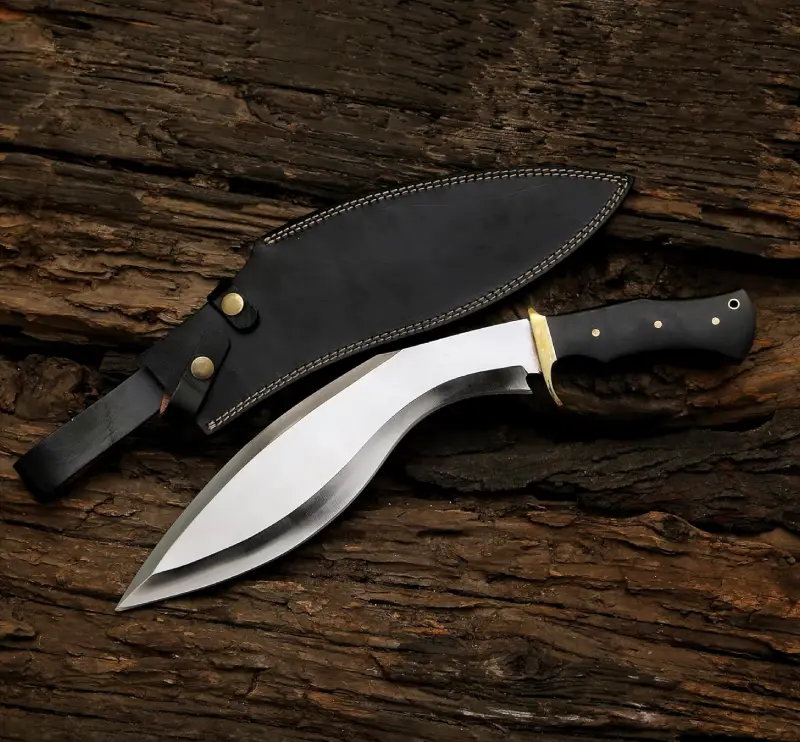
- Full-tang Sandvik 12C27 steel blade. The blade runs the full length of the handle, not a welded rat-tail tang like most budget kukris. Paired with Sandvik 12C27 stainless steel, it holds an edge through heavy chopping and resists rust without constant maintenance.
- Built for real use, not display. At 17 inches overall with a 12-inch blade, this kukri has the length and weight-forward balance to handle trail clearing, firewood prep, and field-dressing game — not just sit on a shelf.
- Comfortable, secure handle. The Micarta G10 handle with a brass guard keeps your grip stable through repeated chopping motions, cutting down on hand fatigue during longer outdoor sessions.
- Hand-forged, individually finished. Each blade is shaped and finished by hand, so no two are perfectly identical — a mark of the craftsmanship, not a flaw.
- Backed by fast, free shipping. Every order ships free worldwide, with no minimum purchase required.
Final Thoughts
A kukri knife is a purpose-built chopping tool with a few thousand years of design refinement behind it, not just a curved novelty blade. What separates a real working kukri from a wall decoration comes down to tang construction and steel quality — details worth checking before you buy, no matter where the knife is made.
Frequently Asked Questions
Is a kukri knife legal to own?
In most of the United States, a kukri is legal to own as a fixed-blade knife, but carry laws vary by state and city, so check your local regulations before carrying one outside your home or campsite.
Is a kukri knife the same as a machete?
No. A machete has a straight or lightly curved blade meant mainly for slashing through vegetation, while a kukri’s sharply forward-curved, weight-forward blade is built for chopping power in a shorter, more maneuverable knife.
What steel is best for a kukri knife?
Full-tang kukris made from 12C27 or 5160 steel are considered reliable choices for real outdoor use, since both hold an edge well and resist the kind of chipping that heavy chopping work can cause in lower-grade steel.
Can a kukri knife be used for hunting?
Yes. Its weight-forward blade makes it effective for field-dressing game and processing carcasses, and many hunters carry one alongside a smaller fixed-blade knife for finer work.